Two Detached ADUs on One Lot: What AB 956 Changes in 2027
Starting January 1, 2027, California cities have to approve two new detached ADUs behind a single-family home instead of one. What AB 956 allows, the fine print, and how it differs from an SB 9 lot split.
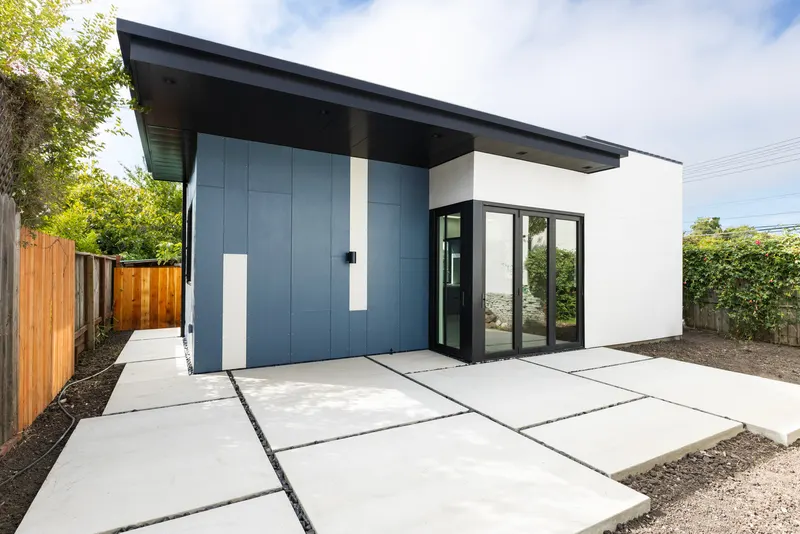
Starting January 1, 2027, California cities and counties have to approve two new detached ADUs behind a single-family home, not just one. The change comes from AB 956, signed by Governor Newsom on September 29, 2026.
That sounds simple, and for the most part it is. But there’s a trade-off with junior ADUs, a size cap your city is allowed to use, and some confusion with SB 9 lot splits, which also get described as “more homes on one lot.” Here’s what the law actually says, based on the bill text and the Legislature’s own analysis.
What changes on January 1, 2027
California’s ADU law has a short list of ADUs that every city must approve “ministerially.” That means staff checks your plans against objective standards and issues the permit. No public hearing and no case-by-case judgment calls.
Until now, that list allowed one new detached ADU on a lot with a single-family home. AB 956 changes the number to two. The bill’s wording is “two detached, new construction, accessory dwelling units” on a lot with an existing or proposed single-family home, in any residential or mixed-use zone.
Two details are worth knowing:
- It applies to new construction. The second unit is a freestanding building, not a garage conversion or a unit carved out of the house.
- “Existing or proposed” includes vacant lots. If you’re building a new house, the two ADUs can be part of the same plan.
The fine print
For these two detached units, the bill only lets your city apply a few specific limits:
- Size: up to 800 square feet of living space per ADU.
- Height: your city can’t set the height limit lower than 16 feet. You can always build shorter; this just guarantees room for a one-story unit with a sloped roof. Near a major transit stop or high-quality transit corridor the limit can’t be lower than 18 feet, plus up to two more feet so the ADU’s roof pitch can match the main house.
- Setbacks: no more than four feet from the side and rear property lines.
Your city can’t add design rules beyond what the statute allows for these units, and it can’t make you fix older problems on the property (like a house that sits too close to a property line) as a condition of approving the ADUs. A few other rules carry over from existing law:
- Rentals have to be longer than 30 days. No short-term rentals.
- You can’t be required to add fire sprinklers to the ADUs if the main house doesn’t need them.
- On a septic system, the city can ask for a percolation test done within the last five years (or ten, if it’s been recertified).
The building code still applies in full. “Ministerial” doesn’t mean “no plan check.” It means the decision is based on clear rules, not opinions.
Many cities’ own ADU ordinances allow bigger units than 800 square feet, so the state rules are a floor, not a ceiling. Whether your city will apply its larger limits to one or both of your detached units is a question to ask early in design.
The junior ADU trade-off
A junior ADU (JADU) is a unit of up to 500 square feet built inside the main house, often in a spare bedroom or an attached garage. Under current law, many single-family lots can have a JADU plus ADUs.
AB 956 adds one exception: if you build two new detached ADUs, your city doesn’t have to approve a JADU on the same lot. Some cities may still allow one, but the state doesn’t guarantee it.
The Senate’s analysis explains why. State law already lets most single-family lots reach about four homes (through SB 9 duplexes plus ADUs, or SB 9 lot splits), and lawmakers wanted to keep that four-unit ceiling. Read together with the rest of the statute, the most you can count on is the main house, one ADU converted from existing space such as a garage, and two new detached ADUs. That’s four homes on one lot.
In practice, most owners choose between:
- One detached ADU, plus a JADU or garage conversion. Better if you have a garage or underused space in the house to work with.
- Two detached ADUs. Better if you have the yard and want two fully separate units, each with its own entrance and no shared walls with the main house.
Fees: a second law signed the same day
Governor Newsom also signed SB 1117 on September 29, 2026, which changes how impact fees work for ADUs. Under current law, ADUs of 750 square feet or less don’t pay impact fees, and larger ADUs pay a share based on their size compared to the main house.
SB 1117 makes that more forgiving for lots with up to two ADUs: if an ADU is over 750 square feet, the impact fee is only charged on the square footage above 750. A 790-square-foot ADU would be charged on 40 square feet, not on the whole unit.
Two things to know:
- Utility connection fees are separate. For a new detached ADU, a water or sewer district can still require its own connection and charge a fee, scaled to the unit’s size or plumbing fixtures. On a two-ADU project, those costs can add up, so ask your water and sewer providers early.
- Lots with more than two ADUs keep the older rule, where fees are based on the whole unit.
For anyone designing two units, the 750-square-foot line is now a meaningful number. Going slightly over it costs much less than before, but staying at 750 still means no impact fees at all.
What AB 956 doesn’t change
- You can’t sell an ADU separately. The ADUs stay tied to the main house. The only exception is AB 1033, which only works in cities that have opted in.
- No owner-occupancy requirement for ADUs. State law doesn’t require you to live on the property to build or rent a standard ADU. JADUs are different: if a JADU shares a bathroom with the main house, the owner generally has to live in one of the two.
- Your site still has to work. The law guarantees approval of two units that meet the standards. It doesn’t guarantee that two 800-square-foot buildings fit on your lot with four-foot setbacks, a way in for each one, and room for utilities.
AB 956 also tightens an existing rule for homeowners associations. Since 2020, HOAs haven’t been able to use their CC&Rs to block or unreasonably restrict an ADU on a lot “zoned for” single-family use. The bill changes that to lots “zoned to allow” single-family use, which closes a gap the Senate analysis says could let an HOA block ADUs on lots zoned for more than one unit. HOAs can still set reasonable rules, as long as those rules don’t make an ADU impossible or unreasonably expensive.
What this means in Marin and the Bay Area
Not every city welcomed this. The Senate’s analysis lists the Marin County Council of Mayors and Council Members among the opponents, along with the League of California Cities and the California Fire Chiefs Association. Opponents’ main concern was that water, sewer, and road systems were planned around fewer homes.
None of that changes the law. The requirement applies to cities and counties directly, so it doesn’t wait for each city to rewrite its ADU ordinance. If you’re planning a project, it’s worth asking the planning department directly how they’re handling AB 956 applications.
On most Marin and East Bay lots, the limit won’t be the law. It’ll be the site. Slopes, mature trees, narrow streets, sewer lines, and fire department access often decide what fits long before the setback rules do. That’s especially true in hillside towns like San Anselmo, Mill Valley, and Larkspur, where usable flat ground is often limited.
If you’re planning an ADU now
You don’t have to wait until 2027 to plan with AB 956 in mind:
- Building one ADU now? Leave room for a second. Place the first unit so a second one could fit later. Run utilities with enough capacity for two, and think about the path to each unit.
- Planning two from the start? Look hard at the 750-square-foot fee line, whether a JADU matters more to you than a second detached unit, and whether your city’s ordinance allows a bigger unit than the state minimum.
- Building a new house? The house and both ADUs can be designed together, which usually makes utilities, access, and grading simpler and cheaper.
If you’re early in the process, can I build an ADU on my property? covers the first feasibility questions, and our ADU process guide walks through a project from first idea to final inspection.
How AB 956 differs from SB 9
People mix these two up because both are described as “more homes on a single-family lot.” They work very differently.
SB 9 (2021) is about the land. It lets you do one or both of two things on a qualifying single-family lot: split it into two separate lots, or build two primary homes on it. If you split the lot, each new lot can have up to two homes, and each lot can be sold on its own.
AB 956 never divides the land. The house and both ADUs stay on one lot, with one owner and one deed.
Some key differences:
- Selling: An SB 9 lot split creates parcels you can sell separately. AB 956 ADUs can’t be sold apart from the house, except under AB 1033 in cities that allow it.
- Living on site: For an SB 9 lot split, you must sign an affidavit saying you plan to live in one of the homes as your main residence for at least three years. AB 956 has no owner-occupancy requirement.
- Where it applies: SB 9 only works in single-family zones within urbanized areas, and excludes many properties, including historic landmarks, some historic-district properties, certain hazard and environmental sites, and projects that would demolish or alter a home rented to a tenant in the last three years. AB 956 applies to any lot with a single-family home in a residential or mixed-use zone (in the coastal zone, a city’s certified coastal plan can still add limits).
- Paperwork: An SB 9 lot split needs a parcel map, a survey, and recorded documents for the new lots. An AB 956 project is a building permit.
- Unit count: Both land in about the same place: around four homes from one original lot. SB 9 gets there by splitting the lot (two homes on each new lot). AB 956 gets there with the house, a conversion ADU, and two detached ADUs on one lot.
In short: if your goal is rental income, family housing, or a place for aging parents, AB 956 is usually the simpler route. If you want separate pieces of property that can be sold or financed independently, that’s what SB 9 is for. For more on how lot splits and condo-style ADU sales compare, see our AB 1033 article.
Common questions
When does AB 956 take effect?
January 1, 2027. Governor Newsom signed it on September 29, 2026. Until then, the state only guarantees one new detached ADU on a single-family lot, though some cities already allow more under their own rules.
How big can each of the two ADUs be?
Under the state’s guaranteed path, your city can cap each detached ADU at 800 square feet of living space, require side and rear setbacks of up to four feet, and limit height to 16 feet in most cases (18 feet near major transit, plus up to two more feet to match the main house’s roof pitch). Your city’s own ADU ordinance may allow larger units, so check both.
Can I still add a junior ADU if I build two detached ADUs?
Your city doesn’t have to approve one. AB 956 says that once two new detached ADUs are built on the lot, the city is not required to also approve a junior ADU. Some cities may still allow it, but you can’t count on it.
Can I sell one of the ADUs separately?
Not by default. AB 956 doesn’t change the rule that an ADU stays with the main house. The only route to selling an ADU on its own is AB 1033, and that only works in cities that have opted in, which no Marin city has done yet. If you want separate, sellable lots, SB 9 is the law built for that.
Is AB 956 the same as SB 9?
No. SB 9 lets you split a single-family lot into two lots, or build two primary homes on one, and it comes with a three-year owner-occupancy promise for lot splits. AB 956 doesn’t split anything. The house and both ADUs stay on one lot with one owner, and there’s no owner-occupancy requirement for the ADUs.
The bottom line
AB 956 doesn’t raise the total number of homes a single-family lot can reach. It changes the mix. Starting in 2027, owners with the yard space can build two freestanding ADUs instead of having to fit the second unit inside the house or garage. For a lot of families, that’s the more useful layout: two separate homes with their own entrances and no shared walls. The lots that make the most of it will be the ones planned with both units in mind from the start.
Sources: AB 956 (2026) bill text, Chapter 791, Senate Floor Analysis of AB 956 (September 14, 2026), SB 1117 (2026) bill text, Chapter 809, Government Code § 66321 (ADU height limits), Government Code § 66411.7 (SB 9 lot splits), HCD Housing Law Fact Sheets (April 2026), and the Governor’s September 29, 2026 bill signing announcement. Details were current as of October 2026. Cities will be updating their rules through 2027, so confirm the current requirements with your planning department before you design.
Thinking about two ADUs?
Burton Builders designs and builds ADUs across the Bay Area and Marin. If you want to know whether two units fit on your lot, or where to put the first one so a second can follow, start a conversation about your property.