An ADU contractor’s straight story on building in San Rafael.
We’re a licensed ADU contractor working across Marin, and we’ve built multiple ADUs in San Rafael — detached cottages, garage conversions, backyard studios with lofts. Neighbors still call them granny flats or in-law units; the code calls them ADUs. This guide covers what the city’s process actually looks like: the size and height rules, where the fees hide, and what changes when your lot is on a hillside or in a fire zone.
What it's actually like to build here.
San Rafael is where most of our Marin work happens, and it’s a city of very different lots: flat streets near downtown and the Canal, Eichler neighborhoods in Terra Linda, and steep wooded parcels that climb toward the ridgelines. The right ADU approach depends heavily on which of those you own.
On paper, San Rafael’s ADU ordinance (Municipal Code 14.16.285) dates to 2022 — and the city itself notes that where it conflicts with newer state law, state standards win. In practice that means staff apply the current state rules, and a contractor who only reads the local code will get some things wrong. Conforming ADUs are approved ministerially through the building permit — there’s no design review hearing, no neighbor sign-off, and the city has to decide within 60 days of a complete application.
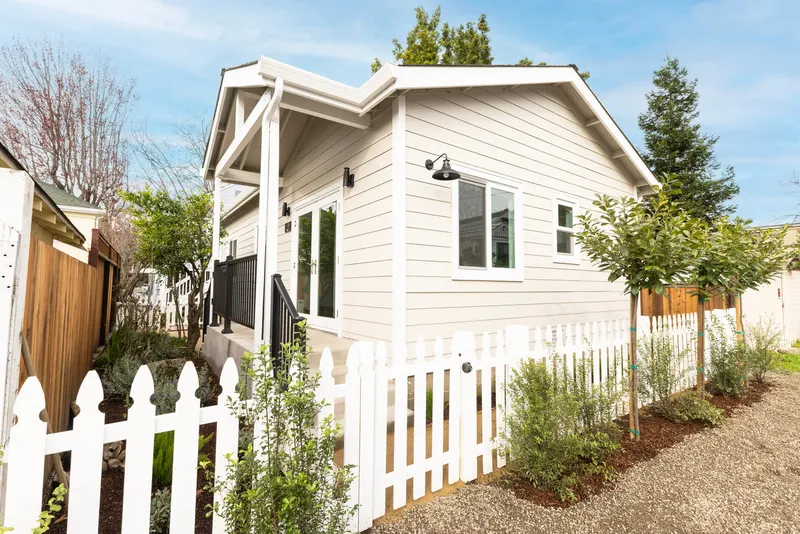
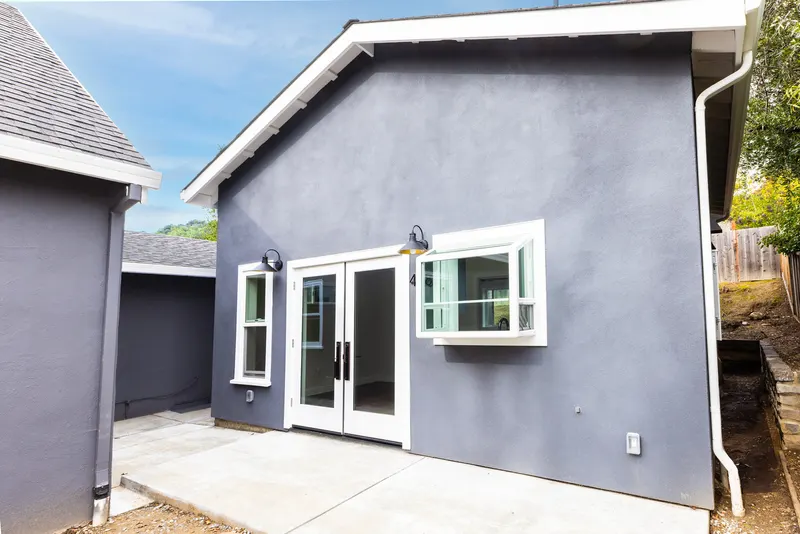
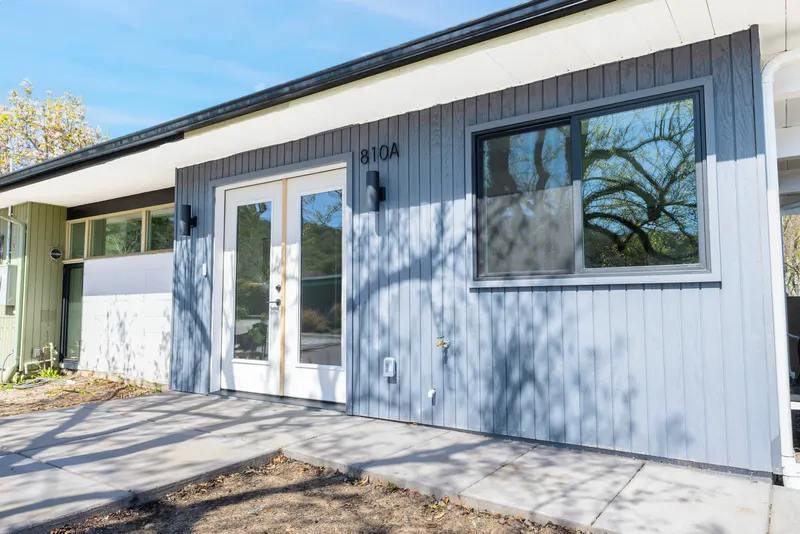
The projects on this page are ADUs we permitted and built here. We’ve been through San Rafael plan check enough times to know where it goes smoothly and where it doesn’t.

Burton Builders is a member of the Marin Builders Association, the county trade association for contractors, suppliers, and design professionals. It is part of how we keep current on San Rafael's permit process, Marin code changes, and the local trades we hire.
San Rafael ADU rules, summarized.
Attached ADUs: 1,000 sq ft or half the main home, whichever is less — but 800 sq ft is always allowed. Conversions of existing structures have no size cap.
Attached ADUs can go to 25 ft. In the Eichler–Alliance overlay (Terra Linda), attached ADUs cap at 17 ft to protect the flat-roof streetscape.
Converting an existing legal structure — a garage, say — requires no additional setback.
Ministerial review through the building permit. Applications go through the city’s OpenGov portal (since February 2026).
Also waived below 750 sq ft: the general plan maintenance fee, street maintenance fee, and bedroom taxes.
A single-family lot can add a detached or attached ADU plus a junior ADU (150–500 sq ft inside the main home).
Checked against San Rafael's published rules as of July 2026. Cities update their ADU standards regularly — always confirm current requirements with San Rafael's planning and building departments, and we re-verify everything against the current code at the start of every project.
How San Rafael reviews an ADU
Everything runs through the Community & Economic Development Department at 1400 Fifth Avenue — Planning review is folded into the building permit application rather than handled as a separate entitlement. For a conforming ADU there is nothing discretionary about it: no design review board, no public notice, and a 60-day clock on the decision once your application is complete. “Complete” is the operative word — an application missing a Title 24 energy report or a survey gets bounced, and the clock restarts.
Since February 2026, applications and inspection scheduling go through the city’s OpenGov portal — instructions you’ll find elsewhere referencing the old eTRAKiT system are stale.
One thing worth knowing before you read the municipal code yourself: it was last updated in 2022, and the city acknowledges that newer state ADU law supersedes it wherever the two conflict. Staff review against current state standards. This is exactly the kind of gap where an experienced ADU contractor earns their fee — we design to what plan check will actually apply, not to what the code page says.
What it costs, and the 750-square-foot line
San Rafael doesn’t publish flat ADU fee amounts. Planning fees are folded into the building permit and calculated from project valuation, with separate flat-rate electrical, plumbing, and mechanical permits on top. The city offers a fee estimator through its Building Division, and we price permits into every proposal so there’s no mystery line item later.
The number that matters most is 750. Below 750 square feet, San Rafael waives impact fees, the general plan maintenance fee, the street maintenance fee, and bedroom taxes. Cross that line and those charges all land. A 749-square-foot ADU and an 800-square-foot ADU are very different projects on paper — it’s one of the first conversations we have with San Rafael homeowners, because the answer shapes the whole design.
Utilities depend on where you are. Southern and central San Rafael is served by the San Rafael Sanitation District; Terra Linda and the north end fall under Las Gallinas Valley Sanitary District — each with its own connection rules and fee schedule. On the water side, Marin Water doesn’t charge a capacity fee for ADUs converted within existing space, but a new detached unit may need its own connection and a capacity charge sized to the ADU. We chase these numbers down per-address during feasibility, because they can swing a budget by thousands.
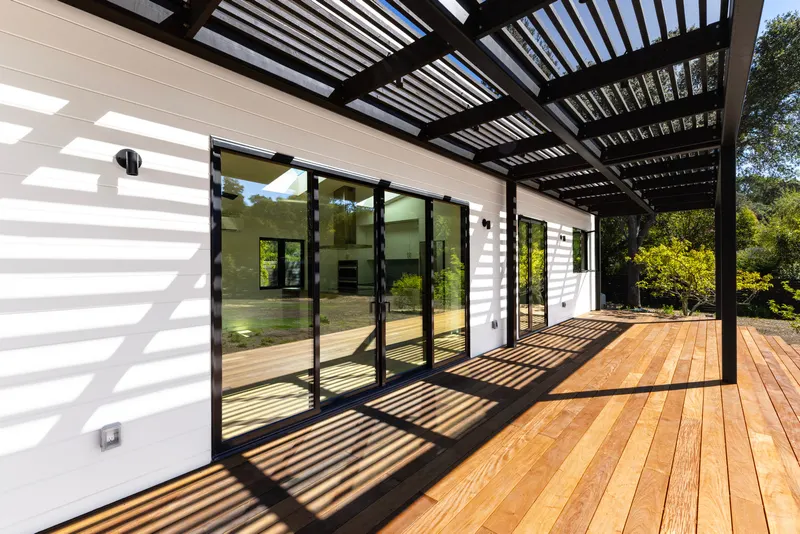
Moncada Way
A 672-square-foot detached one-bedroom — deliberately under San Rafael’s 750-square-foot line, so the project kept its impact-fee waivers while still fitting a covered redwood deck and a full sliding-glass wall on a tight backyard footprint.
See this projectHillsides and fire zones — the San Rafael reality
A large share of San Rafael’s residential land is steep, wooded, or both, and the city’s rules reflect it. If your parcel is in the Wildland-Urban Interface (the Fire Department publishes the map), expect ignition-resistant construction detailing and defensible-space requirements around the new unit — Marin Wildfire Prevention Authority inspectors come through roughly every other year, and the city’s vegetation rules prohibit almost all planting within five feet of any structure. That zone-zero strip is worth designing around from day one rather than fixing after an inspection.
Hillside lots add engineering: earthwork beyond about 50 cubic yards triggers a grading permit with an erosion-control plan, and geotechnical review comes with it. Foundations get more expensive on slope — drilled piers instead of a slab, retaining where the pad needs cutting. None of this is a dealbreaker; most of our Marin ADUs sit on lots like these. It just needs to be in the budget from the first conversation, not discovered in plan check.
It also means the fast paths mostly don’t apply here. San Rafael has a pre-approved ADU plan program on the books, but it excludes hillside, fire-zone, geologic-hazard, and tsunami-zone parcels — which is to say, a big share of the city. For most San Rafael lots, a site-specific design is the realistic route.
Neighborhood quirks worth knowing
Terra Linda’s Eichler–Alliance overlay caps attached ADUs at 17 feet so additions don’t loom over the flat-roof neighborhood — if you own an Eichler, the ADU should be designed to the overlay from the start.
Your height limit also depends on transit: detached ADUs are 16 feet as a baseline but 18 feet within a half-mile walk of a major transit stop, and the city publishes a transit buffer map worth checking before you assume the lower number.
Two more geography notes. Low-lying Canal-area lots sit in a FEMA flood zone, where finished-floor elevation requirements apply — confirm the base flood elevation with the Building Division early. And a few “San Rafael” addresses — Santa Venetia, Los Ranchitos, Country Club — are actually unincorporated Marin County pockets, which means county ADU rules and county reviewers, not the city’s. It’s worth verifying which side of the line you’re on before planning anything.
C Street
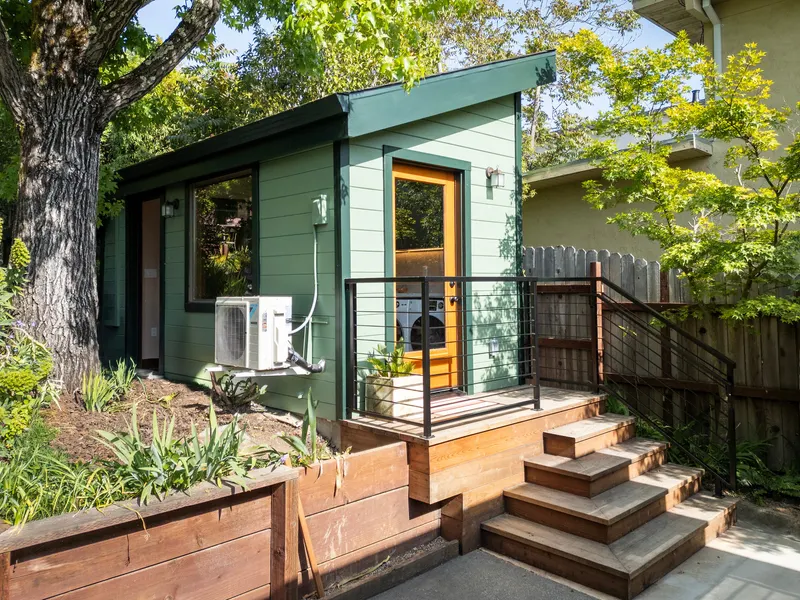
A 299-square-foot garage conversion. Conversions are the quiet workhorse of San Rafael’s ADU rules — no added setbacks, no size cap tied to the existing structure — and this one turned a dated garage into a cedar-lined studio without touching the lot’s footprint.
See this projectProjects we've built in San Rafael.
San Rafael ADU questions, answered.
How long does it take to get an ADU permit in San Rafael?
How big can I build an ADU in San Rafael?
Can I convert my garage into an ADU?
Does my San Rafael ADU need fire sprinklers?
What does a hillside lot add to the project?
Can I rent out my San Rafael ADU?
Official San Rafael ADU resources.
- City of San Rafael — ADU information page
- City of San Rafael — ADU & JADU fee FAQ
- City of San Rafael — pre-approved ADU plans
- City of San Rafael — building permits
- ADU Marin — San Rafael local rules
Links verified July 2026. This guide is general information, not legal or permitting advice — rules change, and every property is different. Before making decisions, confirm current requirements with San Rafael's planning and building departments through the official resources above.
Thinking about an ADU in San Rafael?
Tell us about your lot and what you want to build. We'll give you a straight read on feasibility, budget, and what San Rafael's process will look like for your property.