A Pleasanton ADU contractor’s advice: watch the water meter.
Pleasanton makes the permit side of an ADU genuinely easy — no planning fee, a 15-business-day review target, and a preapproved-plan lane that cuts that to seven. The money side has one lever that towers over everything else: whether your project stays on the house’s existing water meter. We’ve built a backyard ADU here, and this guide walks through the rules, the fee math, and the design decisions that keep a Pleasanton granny flat on the friendly side of both.
What it's actually like to build here.
Pleasanton’s ADU ordinance is about as current as they come — the city re-adopted it in full in October 2025, and its handouts already reflect the newest state law. The process is ministerial, planning review is free, and the city publishes a 15-business-day review target against the state’s 60-day ceiling. For homeowners who want an in-law unit or a long-term rental, the approval path is one of the smoother ones we work with in Alameda County.
The catch in Pleasanton isn’t process — it’s plumbing. City impact fees zero out below 750 square feet, but sewer connection fees run roughly twelve dollars a square foot across two agencies, and if your project triggers a new or upsized water meter, Zone 7’s wholesale connection charges enter six-figure territory. The single most valuable thing a contractor does here is design the unit — fixture by fixture — to stay on the existing meter.
Below: how the rules and the review actually run, the design-matching checklist, the honest fee math, and what changes if your lot backs up to the ridgelands.
Pleasanton ADU rules, summarized.
850 sq ft for a studio or one-bedroom, 1,000 for two-plus bedrooms. Conversions of existing space can exceed the caps, and the state’s 800 sq ft detached unit is always available.
18 ft within a half mile of major transit (plus 2 ft to match the main roof pitch). Attached ADUs can reach 25 ft and two stories.
No fee for planning review, with a 15-business-day review target. Using a city-preapproved plan drops review to 7 business days for a flat $1,000.
Capital facilities, transportation, and Zone 7 storm-drain fees all drop to zero below 750 sq ft. School fees apply only above 500 sq ft.
Tandem or driveway parking counts, and the space is waived near transit, in historic districts, and for conversions. Garage conversions replace nothing.
A new or upsized water meter triggers Zone 7 connection fees that can exceed $100K. Designing to the existing meter is Pleasanton’s biggest single cost decision.
Checked against Pleasanton's published rules as of July 2026. Cities update their ADU standards regularly — always confirm current requirements with Pleasanton's planning and building departments, and we re-verify everything against the current code at the start of every project.
A permit counter that has done its homework
Pleasanton comprehensively re-adopted its ADU chapter in October 2025, so the rules you read match the rules staff apply — including the latest state allowances, like legalizing unpermitted ADUs built before 2020 and up to eight detached units on multifamily lots. Review is ministerial: meet the objective standards and the city approves without hearings. There is no planning fee, applications go through the city’s online permit portal, and the city’s published target is 15 business days against the 60-day statutory clock.
The city also runs its own preapproved-plan program: submit a design already in the city’s catalog and plan review drops to seven business days for a flat $1,000. On a single-family lot, state law guarantees room for a converted ADU, a detached ADU up to 800 square feet, and a JADU; the city’s handout describes an attached-plus-detached combination as well, so if your plans involve more than one unit, have Planning confirm the exact combination for your lot before you invest in drawings.
One deadline worth knowing if your project is already moving: the city’s ADU rebate program — $2,500 to $10,000 depending on size and affordability restrictions — only covers permits issued through August 31, 2026, and requires a certificate of occupancy by September 30, 2026. For a project starting from scratch today that window has effectively closed, but a fast conversion already in plan check may still qualify. Ask before you assume either way.
Size, height, and the match-the-house checklist
The size caps are the standard state-minimum pair — 850 square feet for a studio or one-bedroom, 1,000 for two or more bedrooms — with 4-foot side and rear setbacks, a 10-foot street-side setback for units over 800 square feet, and 16 feet of height for detached units (18 near major transit, 25 feet and two stories for attached). Conversions are the loophole worth knowing: an existing garage or accessory structure can become an ADU beyond the size caps, keeping its existing height and setbacks. Above 800 square feet, the lot’s floor-area ratio and open-space rules wake up; at or under 800, they can’t be used to shrink the unit.
Pleasanton’s design standards are objective and specific: the ADU matches the main house’s wall material, trim, roof form and slope, window proportions and detailing, even railing design. An ADU within 10 feet of a side or rear property line needs a six-foot solid fence plus landscaping that will screen it at maturity. Second-story windows within 25 feet of a property line get five-foot sills or obscured glass, and usable balconies and roof decks are flatly prohibited. Much of Pleasanton sits in planned unit developments, whose standards apply to larger units too — one more reason the state-exempt 800-square-foot design is often the path of least resistance.
Corte Sonada
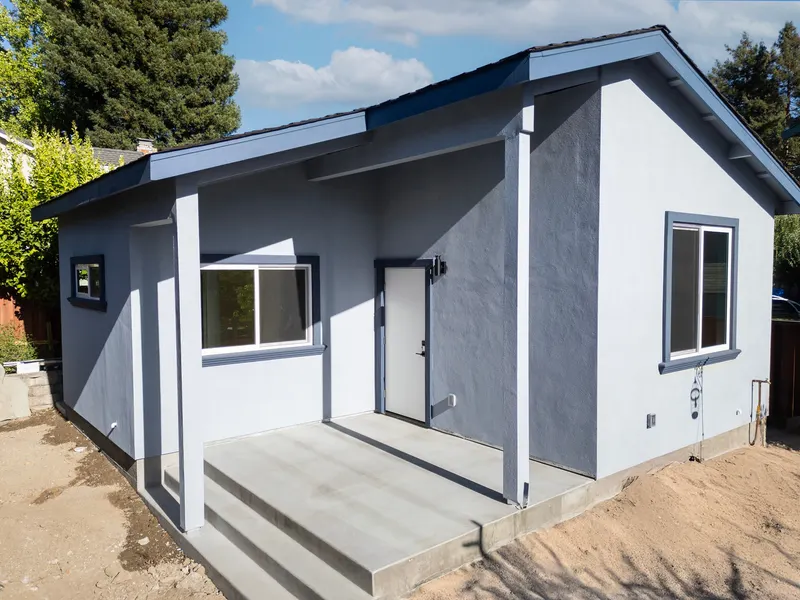
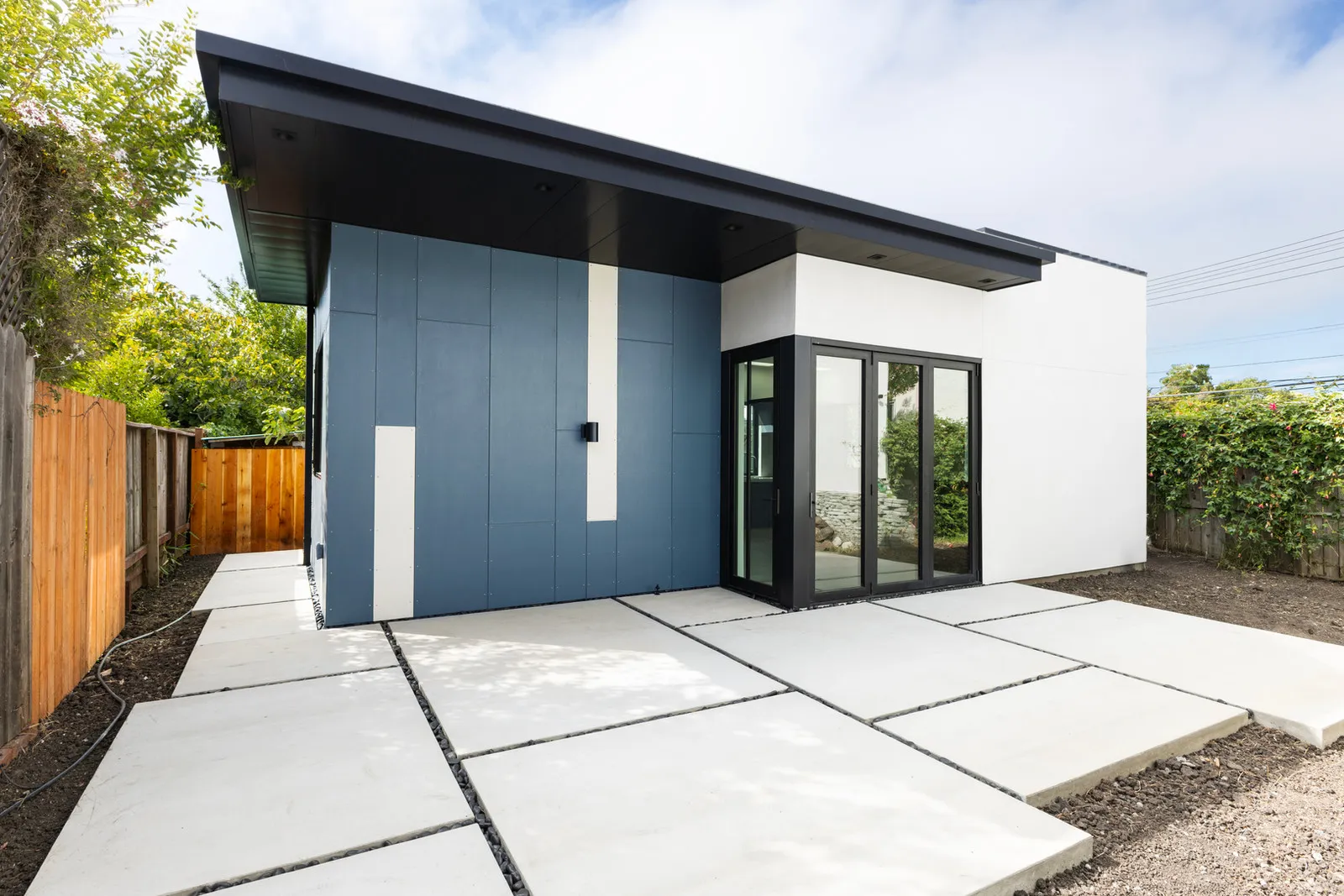
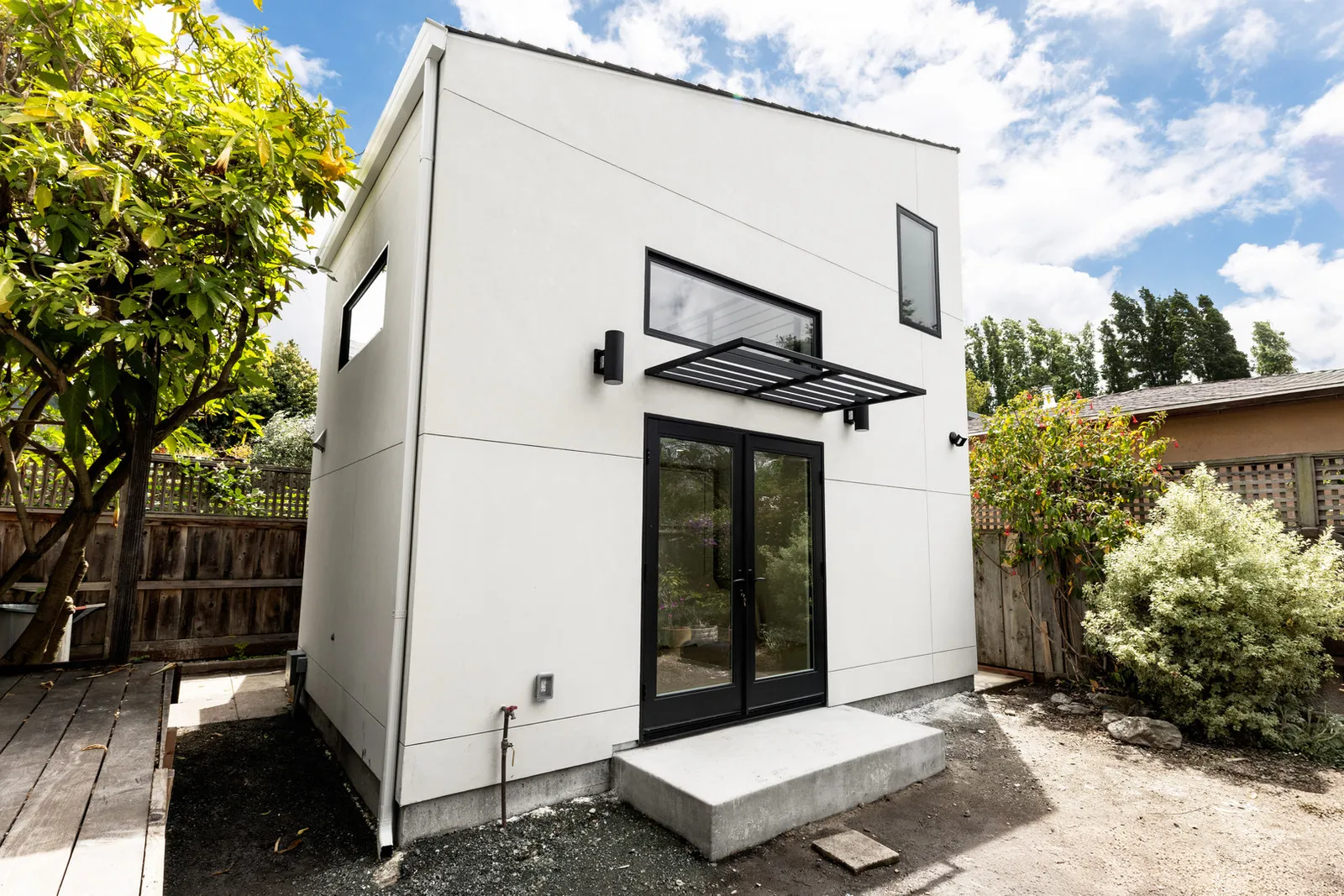
A 456-square-foot detached one-bedroom in Pleasanton — comfortably under the 750-square-foot line where the city’s capital-facilities, transportation, and storm-drain fees all drop to zero, and inside the 850-square-foot cap for a one-bed. Ductless mini-split heating and cooling suits the all-electric standard Pleasanton applies to new detached units.
See this projectThe fee math — and the meter that decides it
Below 750 square feet, Pleasanton’s own development fees essentially vanish: capital facilities, transportation, Tri-Valley transportation, and the Zone 7 storm-drain fee all read zero, and there is no affordable-housing fee on ADUs at any size. From 750 to 1,000 square feet the city charges modest per-square-foot rates. School fees are separate — Pleasanton Unified charges per square foot on projects over 500 square feet, paid directly to the district before permit issuance.
Sewer is the fee you plan around: the city collects roughly $2 per square foot for its own system plus close to $10 per square foot for DSRSD, the agency that treats all of Pleasanton’s sewage — call it about $9,000 on a 750-square-foot unit. Whether a pure garage or interior conversion pays those connection fees is a question worth settling with Building & Safety at plan check, because state law treats units inside existing space differently.
And then the meter. Water connection fees in Pleasanton are triggered by a new or upsized meter, not by the ADU itself — and Zone 7’s wholesale charge on a standard new residential meter runs into six figures. The city’s own plan-check process asks for water-fixture-unit calculations showing the existing meter can carry the ADU, and units within existing space are entitled to skip the upgrade entirely under state law. This is where experienced design pays for itself: pick fixtures and appliances to fit the meter you already have.
All-electric, rentals, and the ridgelands
Two build requirements to know going in: new detached ADUs in Pleasanton are all-electric — no gas connections, per the city’s reach code — and carry rooftop solar under the state energy code. Attached and converted units can keep gas and skip solar. Fire sprinklers follow the main house: required in the ADU only if the primary home has them.
On the rental side, Pleasanton allows ADU rentals of 30 days or longer — no short-term rentals — and owners who rent their ADU participate in the city’s rent-monitoring program, an unusual requirement among East Bay cities. Owner-occupancy is not required for a standard ADU.
In the hills, the picture is more forgiving than most homeowners expect. Measure PP’s ridgeline and steep-slope protections exempt developments of ten or fewer housing units per the city’s General Plan, so a single ADU isn’t automatically barred — though on a ridgeline lot we’d confirm the specifics with Planning before designing. What does apply is fire: Livermore-Pleasanton Fire reviews ADU projects, and parcels in the 2025 state fire-hazard maps’ High and Very High zones carry wildland-interface construction standards and defensible-space requirements. Look your parcel up on LPFD’s map before you fall in love with a site plan.
Projects we've built in Pleasanton.
Pleasanton ADU questions, answered.
How long does ADU permitting take in Pleasanton?
How big can I build?
What will the fees actually look like?
Do I need to add parking?
Can I rent out my Pleasanton ADU?
My lot is in the hills. Can I still build?
Official Pleasanton ADU resources.
- City of Pleasanton — ADU information page
- City of Pleasanton — ADU & JADU handout (May 2026, PDF)
- Pleasanton Municipal Code — Chapter 18.106 (ADUs & JADUs)
- City of Pleasanton — development fees handout (Feb 2026, PDF)
- Pleasanton USD — developer fees
- Livermore-Pleasanton Fire — fire hazard severity zones
- Zone 7 Water Agency — connection fee schedule (PDF)
Links verified July 2026. This guide is general information, not legal or permitting advice — rules change, and every property is different. Before making decisions, confirm current requirements with Pleasanton's planning and building departments through the official resources above.
Thinking about an ADU in Pleasanton?
Tell us about your lot and what you want to build. We'll give you a straight read on feasibility, budget, and what Pleasanton's process will look like for your property.